Progress update
Decomposing difficult tasks is ... difficult
The system in which reasoning LLM decomposes complex tasks into simpler ones for a weaker LLM to implement loses with single zero-shot thinking LLM but wins with zero-shot non-thinking model. This leaves a lot of room for improvement.

In our previous post we have introduced motivation and goals for our project. Now we can move forward and elaborate on the practical setup in which we will answer our questions and show baseline behaviour of our system.
Setup
We focus first on coding tasks using open-r1/codeforces (verifiable) dataset.
In the project we introduce a system of two components: broadly defined strong AI (for our purposes it means a reasoning model) and a weaker component (non-reasoning AI or a human). In practice we consider, in general, four configurations which have prefix either Direct, or Decomp:
- Direct-T: direct zero-shot solver with thinking on (T),
- Direct-F: direct zero-shot solver with thinking off (F),
- Decomp-TF: a system of decomposer model with thinking on (T) and implementer model with thinking off (F).
Apart from this we have performed ablation studies on Decomp-FT (decomposer with thinking off and implementer with thinking on) and Decomp-FF (both models with thinking off) configurations.
The Decomp pipeline has four steps:
- Decomposition: the strong model reads the task statement and writes a short chain of function docstrings.
- Implementation: the weaker model writes each function from its docstring alone.
- Composition: the functions are chained into one program.
- Scoring: the program runs in a sandbox against the task’s unit tests; a task counts as solved only if every test passes.
We use Direct configuration as a baseline to compare our decomposing pipeline against a zero-shot solver. In particular, Direct-T will not undergo training and becomes our ceiling (how a zero-shot reasoning model deals with the coding task). Direct-F, on the other hand, is our direct baseline which we will train using GRPO alongside our Decomp configuration.
In the first experiments we have used Qwen3.5-4B for both Direct configurations (thinking on/off) as well as decomposer model in the Decomp-TF configuration (thinking on) and Qwen3.5-2B (thinking off) as an implementer model. We have also performed additional evaluations where Qwen3.5-4B (thinking off) implements the same decompositions as Qwen3.5-2B before.
Baseline
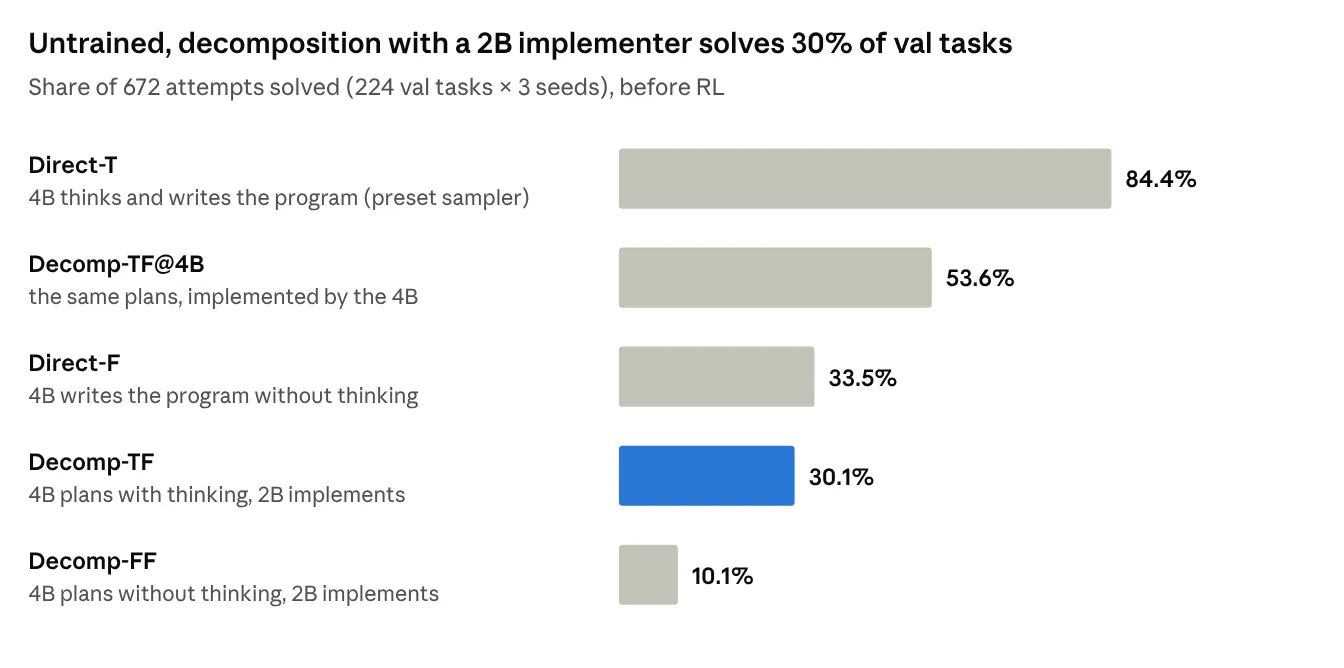
Untrained decomposition with a 2B implementer lands just below the 4B solving the task without thinking, and far below the 4B thinking.
Four things stand out:
- Thinking is worth about 46 points when solving directly. Under the same sampler, the 4B goes from 38.8% without thinking to 84.4% with it. Most of Direct-T’s remaining failures are answers cut off at the 32,768-token budget.
- The 2B implementer costs more than the decomposition gains. Handing Decomp-TF’s own docstrings to the 4B instead of the 2B lifts the solve rate from 30.1% to 53.6%. That beats the 4B writing the program directly without thinking (33.5%), so the plans carry real information; the 2B loses much of it.
- Most interface errors are the implementer’s. In 17% of the 2B’s programs a helper cannot be called the way the chain expects, usually because it takes the wrong arguments. On the same docstrings the 4B makes this error in 0.3% of programs.
- The decomposer needs to think. With thinking off (Decomp-FF), the decomposer solves 10.1%. It does its reasoning inside the JSON strings instead (“Actually, …”, “Final decision for function 2: …”), and 17% of its answers fail to parse, mostly on a missing comma between docstrings.
Implications for AI safety
The preliminary results leave a lot of headroom for the decomposing system to learn. Currently there is a capability gap between the Decomp system and a single reasoning model (Direct-T). The decomposition system suffers from failure modes that a single reasoning model doesn’t (for example interface issues between the decomposer and implementer as well as program composition). The gap can be partially closed by having a stronger implementer (still non-reasoning) or with further training.
Next
We perform RLVR training using GRPO on our decomposer/implementer system and see if we can achieve better decompositions than our baselines and analyse failure modes that arise.